Overview
The AI Metrics Details dashboard is opened from the AI Metrics Dashboard and provides a detailed view of AI usage metrics at the task level.
AI Agents
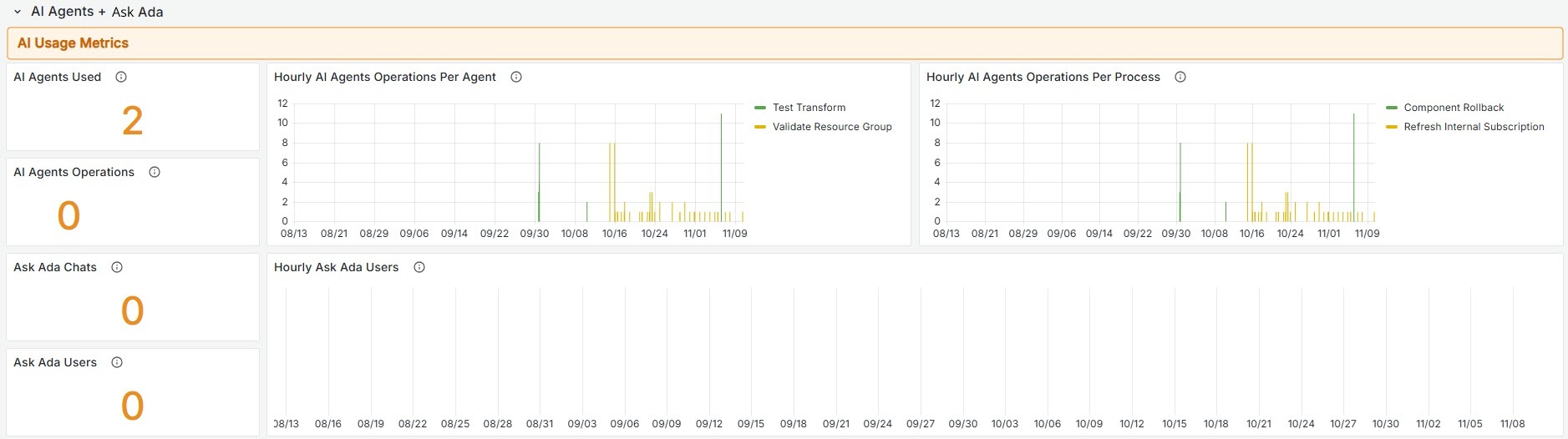
AI Agents Operations
Display the total number of AI Agent operations executed within the selected time range, focusing on the tasks associated with AI Agents.
The accompanying time series graph shows how AI Agent operations evolve over time for each task, helping identify usage trends, spikes in demand, or periods of reduced activity. The information is useful for understanding overall AI workload and adoption patterns.
Total AI Agent Operations
Shows the number of AI Agent operations conducted within the selected date range. The metric is useful for monitoring the frequency and distribution of AI Agent activities, providing insights into operational peaks and periods of inactivity.
AI Agents Distribution
The AI Agent Distribution section provides insight into how AI Agents are embedded and consumed across tasks.
It helps you understand where AI Agents are being used, how they are integrated, and which business areas rely on them most.

Dependency type distribution
Shows the distribution of AI Agent dependencies by dependency type. Each segment represents a different way in which AI Agents are integrated into the platform, such as:
•Activity Forms
•Entity Forms
•Agent Tasks
The total number in the center represents the total count of AI Agent dependencies detected within the selected scope. The percentage and count for each segment indicate how frequently AI Agents are referenced through a specific dependency type.
Dependency Type by Task
Illustrates the distribution of dependency types per task using a stacked horizontal bar chart. Each bar represents a task, and the colored segments within each bar indicate the proportion of dependency types, such as Activity Forms, Pipelines, or Agent Tasks, used by AI Agents in that task. The bars are normalized to 100%, making it easy to compare relative usage patterns across tasks.
AI Workers
AI Workers Accuracy
This subsection presents AI Workers Accuracy metrics at the task level.

AI Worker Accuracy Score by Task
Shows the reliability percentage for each task enabled with AI Workers. The accuracy score is calculated based on human modifications made to Form fields after the AI Worker has completed its task. Tasks requiring fewer human corrections receive higher accuracy scores, while tasks needing significant intervention receive lower scores.
The metric helps assess the effectiveness of AI Worker training at a granular level and identifies specific tasks that may require improvement.
Autonomous Execution Rate
Provides autonomous execution metrics for AI Workers at the task level, offering key performance indicators to evaluate reliability and automation effectiveness for specific tasks.

Autonomous AI Worker Success Rate by Task
Shows the percentage of successful executions for each autonomous task completed without human intervention. The metric serves as a key performance indicator for assessing AI Worker reliability at a granular level. High success rates indicate well trained and robust AI Workers capable of independently handling assigned tasks.
Autonomous AI Worker Failure (Fallback) Rate by Task
Displays the percentage of failed executions for each autonomous task that required manual intervention to proceed. Failures may result from unexpected errors or edge cases not covered by the AI Worker's training or rule set.
Monitoring the metric is critical for identifying task specific reliability issues and improving AI Worker robustness in a targeted manner.
AI Worker Feedback
This subsection presents feedback metrics for AI Workers at the task level, providing indicators of user satisfaction and performance quality for specific tasks.

AI Worker Positive Feedback Rate by Task
Shows the percentage of executions for each task that received positive feedback ratings.
The metric reflects user satisfaction and the perceived quality of AI Worker performance at a granular level, helping identify tasks with the most successful AI Worker implementations.
AI Worker Negative Feedback Rate by Task
Displays the percentage of executions for each task that received negative feedback ratings. The information helps identify AI Worker implementations that may require improvement or additional training.
Monitoring negative feedback at the task level is essential for maintaining AI Worker quality.
AI Worker Tasks Without Feedback by Task
Shows the percentage of executions for each task that received neither positive nor negative feedback. High percentages may indicate low user engagement, missing feedback mechanisms for certain activities, or tasks completed without user interaction.
The metric helps identify opportunities to improve feedback collection and increase user participation at the task level.
Last Updated 7/17/2026 11:18:43 AM