Overview
The AI Advisor helps you identify opportunities to optimize your automated processes.
AI Advisor analyzes how your processes operate, identifies tasks with the greatest optimization potential, and recommends how Bizagi AI capabilities can be applied to them. The goal is to discover actionable opportunities for improvement.
The AI Advisor combines operational evidence with information about how your processes are designed to highlight manual tasks where AI could help reduce effort and cycle time. Recommendations currently focus on the use of AI Agents and AI Workers.
The analysis uses two main sources of information: process execution statistics and application metadata.
•Process execution statistics provide evidence of how tasks have performed during the last 30 days of production operation, including factors such as the number of executions, average duration, waiting time, and SLA performance.
•Application metadata provides context about how the process and its tasks are configured. This includes process structure, forms, and elements associated with event actions, such as rules, connectors, pipelines, and templates.
The AI Advisor uses this information to infer the purpose and behavior of a task without accessing customer business data such as names, email addresses, or transactional information.
Using these inputs, the AI Advisor can move beyond showing what is happening in a process and provide guidance on where AI could make a meaningful difference and how it could be introduced into the existing process.
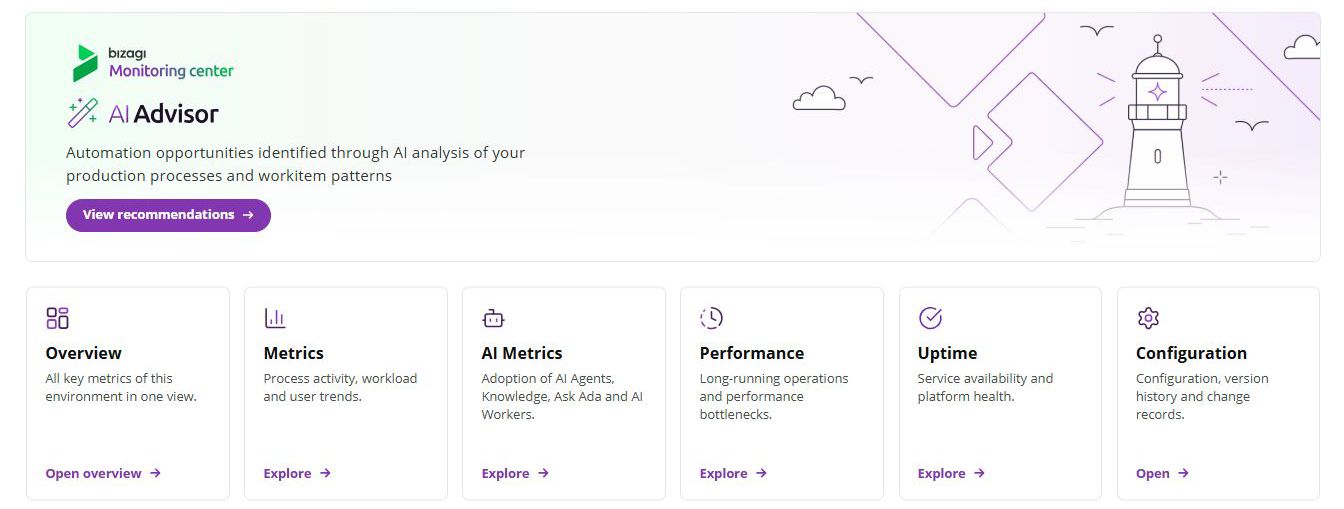
How AI Advisor identifies opportunities
The AI Advisor considers telemetry from the last 30 days of production activity. This provides the operational evidence needed to understand the behavior of individual tasks.
It then prioritizes tasks using a deterministic statistical model. Some of the most important factors in this calculation are the number of executions, average task duration, average waiting time, and SLA performance.
Each task receives an opportunity score from 0 to 100. The higher the score, the greater the potential opportunity identified by the prioritization model.
For tasks that qualify as candidates, the AI Advisor analyzes their application metadata to better understand the context in which they operate. This includes the process structure, forms, and event actions associated with the task.
Finally, the AI Advisor uses AI to enrich the top six opportunities and generate detailed recommendations using AI Agents or AI Workers.
These recommendations are intended to support decision-making rather than automatically modify the process. The process owner ultimately determines whether a recommendation is appropriate based on the actual business context and whether it should be implemented.
What you get from AI Advisor
For the highest-priority opportunities, the AI Advisor provides more than an opportunity score. It explains the potential outcome, the proposed AI-based solution, and the evidence behind the recommendation.
Each detailed recommendation brings together three perspectives:
•Recommendation describes the business opportunity, the expected outcome, and the AI solution that could be introduced into the process.
•Implementation considerations highlight aspects that should be evaluated before implementing the recommendation, such as data, governance, validation, rollout, and human involvement.
•Operational evidence shows the information used to support the recommendation, including the process execution statistics and analysis of process, form, and task configuration.
The resulting recommendation is an AI-assisted estimation. It gives you a data-supported starting point for evaluating an opportunity, while leaving the decision to implement it with the people who understand the process and its business context.
AI Advisor execution
The AI Advisor runs once per month when the feature is enabled. The execution date is not the same for every customer. Each customer has its own scheduled execution date.
You do not normally need to wait 30 days after enabling the AI Advisor before it can perform its first analysis. Telemetry is already being collected, so existing customers can have the required 30 days of historical production information available when the Advisor is enabled. A new customer without sufficient production history needs to accumulate those 30 days of operational information first.
The Advisor performs its analysis in read-only mode: it uses the existing telemetry strategy rather than modifying the telemetry or interfering with process execution.
Enabling AI Advisor
As the AI Advisor is part of the Monitoring Center, you must enable the feature from the AI Advisor settings in the Customer Portal.
When enabled, executions of the AI Advisor consume AI resources, and that consumption is identified in the AI BPU Report.
Disabling the AI Advisor prevents new scheduled executions, as long as it remains disabled. Existing recommendations are not removed immediately: they remain available for the rest of the retention period, which is currently 30 days.
Last Updated 10/27/2026 3:10:24 PM